
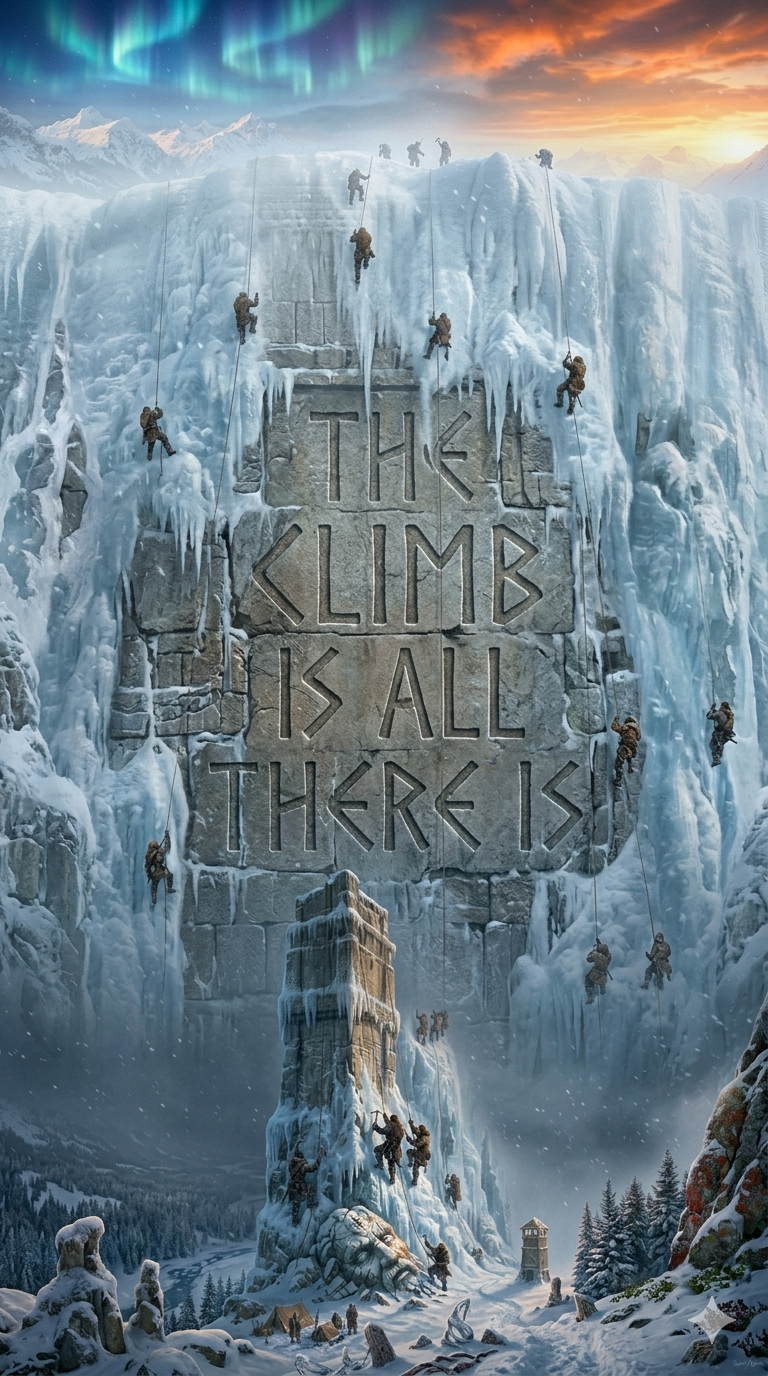
You Know Nothing, Jon Snow:The Climb.
It started innocently enough. With the things people say they know without thinking twice. The kind of knowledge that feels so obvious it never gets inspected. And then you look a little closer, and it begins to thin out. A lot of it turns out to be borrowed confidence.
So you move to safer ground. Science. If anything should hold, it’s that. And it does hold, in a sense, but not as some clean pipeline from world to truth. It starts looking more human than that. Structured, powerful, but not untouched.
So you get closer. Perception. Surely this is immediate, at least. Except it isn’t. What you see, hear, feel, arrives already interpreted, already shaped.
Then inward. The mind itself. The thing doing the shaping. That should be the stable point. It isn’t.
What remains
So after all that, there is a natural temptation to become dramatic. To act as if the only honest conclusion is collapse. To stand in the rubble, pointing at the dust, pleased with oneself for having discovered that nothing is solid. There is another temptation too, more timid but not much better, which is to retreat into softness. To murmur something vague about mystery, or complexity, or the limits of reason, and then quietly leave before anything has to be rebuilt.
I do not think either response is serious enough.
Because once certainty has been cut down this far, the question is no longer whether some perfectly self-grounded foundation is waiting one level deeper. At some point that hope starts looking less like rigor and more like nostalgia. The real question is what a person is left with when the fantasy of total grounding begins to fade. What remains when you stop asking reality to hand you a final receipt for everything you live by.
What remains, I think, is not nothing. It is Choice.
I mean that if you keep digging under almost anything a person takes seriously, at some depth you stop finding proofs and start finding commitments. And for me, this is so beautiful. In a way I can’t even explain.
Take something like your opinions. Politics, ideology, even just what you think is “right.” Of course they feel justified. Of course you have reasons. But close the door, take one of them seriously, and start asking yourself why you hold it. Not to perform, not to defend it, just to follow it down. Why this and not that? Why does this matter? Why does that count as a good reason? Keep going long enough and something shifts. The chain does not end in a final proof. It ends in something like: this is how I see it. This is what I stand by. This is obviously the right thing to do.
What makes it beautiful is not that reason has failed and we are left to improvise in the dark. It is that a person was never meant to live as a spectator. At some point, the demand for one more justification stops being a noble discipline and starts becoming a refusal to inhabit your own position. You do not become serious by waiting for certainty to relieve you of responsibility. You become serious when, having asked what you can ask, tested what you can test, and doubted what deserves doubt, you finally stand somewhere and accept that the standing is yours. Not because it is immune from criticism. But because a life cannot be lived in permanent suspension. There is a moment when not choosing starts masquerading as rigor, when endless hesitation begins to look less like honesty and more like evasion.
At some point, you stop asking not because there are no more questions, but because justification has run as far as it can run, and what remains is no longer the search for one more reason. It is the moment where a person must either stand somewhere or refuse to stand anywhere at all. And that refusal, too, is already a stance.
At some depth, you are recognizing something personal. I’m not saying it is arbitrary or random, I’m saying it is owned. A point where the questioning quietly gives way to something like: this is where I stop.
It is tempting to think that this only applies to soft domains, to opinions, to values. But look at what you call knowledge. How much of what you confidently say you know have you actually traced back yourself? Very little. You do not re-run experiments. You do not check every derivation. You do not personally validate entire fields. You rely on the fact that others have done the work, that systems of correction exist, that the structure holds. And that trust is not foolish. It is necessary. But it is still trust.
And to make myself clear, I do not say that there are no answers. There are. Many things can be explained, demonstrated, tested, refined. But you do not follow all those chains. You follow a few, maybe in areas you care about deeply or specialize in. The rest, you accept earlier. Much earlier. A practical stopping point. A place where understanding is “enough.” And that “enough” is not written into the structure of reality. It is negotiated by your time, your attention, your needs, your limits. In other words, by you.
In a few narrow areas, where it matters to you or where you have expertise, you push further. You ask more questions. You demand more rigor. You are less easily satisfied. But even there, the pattern does not disappear. It just moves. The stopping point is farther, but it is still there. And beyond it, the same thing waits, a principle, an axiom, a choice.
A Different Kind of Grounding
None of this, to me, is a flaw in how we think. It is what makes thinking, and living, possible in the first place. If you refused to stop anywhere, if you insisted on grounding everything all the way down before acting, you would not get very far. You would not decide, you would not move, you would not build anything that lasts. A human life cannot carry infinite justification at every step. It depends on these stopping points, on these layers of trust, on these moments where something is taken as enough. Not because the world ends there, but because you do. Because your time, your attention, your capacity are finite. So you rely, you commit, you move forward. Not perfectly grounded, but sufficiently grounded to live. And that is not a weakness to fix. It is the structure that makes a life possible at all.
Also, to say that things bottom out in commitment is not to flatten all commitments into equivalence. That would be a childish conclusion. Some commitments are barely more than a habit with a moral costume. Some are inherited whole, never examined, never tested, guarded only by familiarity, fear, or the comfort of belonging. Some are cruel. Some are incoherent. Others have been worked on. They have passed through doubt, contradiction, experience, revision, and still remain standing. They are not immune to error, but they are deeper, harder won, more reality-bound. So this is not a celebration of randomness, and certainly not of absurdity. It is not a claim that because certainty runs out, anything can take its place. Knowledge still matters. Science still matters. Principles still matter. Beliefs matter. The point is not that these things dissolve into nonsense, but that even at their strongest, what finally holds them in a life is not infinite proof.
People tend to resist this point because they hear it is a kind of downgrade. As if calling something a choice is already to have reduced it, to have stripped it of seriousness, to have exposed it as nothing more than preference wearing heavier language. As if anything not compelled from the outside by pure logic must be somehow less real. But that picture is too narrow. It confuses choice with whim. A position can be chosen and still be the result of attention, of discipline, of confrontation with reality. It can be shaped by evidence, corrected by error, deepened by experience, hardened by difficulty. A person can arrive somewhere not by drifting, but by returning, revising, refusing, and holding. In that sense, a choice can carry more seriousness, not less, precisely because it is owned. It is not just something that happened to you. It is something you stand behind. It is a different kind of grounding.
Finally, my choice (pun intended) does not escape critique. I know that. I am not pretending to resolve the ancient argument about whether what we call a choice is really ours, or whether it is shaped all the way through by temperament, upbringing, society, genes, neurology, and a thousand forces that were already moving before we became aware of ourselves. Some of that is likely true. Nor am I pretending I arrived here from nowhere, as if I could step outside myself and return with a pure conclusion. I cannot. This position is probably marked, at least in part, by the kind of mind I have. But that does not make it arbitrary. I did not land here casually or out of convenience. I followed the argument as far as I could, let it unsettle what it could unsettle, took objections seriously, and kept going until I reached what felt like the limit of what reasoning could give me. And I tried in 5 long posts to share that with you. However, what remains is not certainty, not an answer beyond question, but a stance. A considered one. One I know may be marked by bias, but one I stand behind nonetheless.
That does not make experience pure. I am not sneaking certainty back in through poetry. Experience too is shaped, filtered, biased, historically formed, entangled with body and memory and expectation. Fine. The point is not that experience is unquestionable. The fact that reason has a ceiling is not a blank check for whatever stands outside it. Not every intuition is signal. Not every feeling is access. The point is narrower than that: explanation is not the only mode in which meaning appears. There are moments when understanding, if that is even the right word, looks less like solving and more like presence.
The cost of knowing too confidently is not usually being wrong, it is the inability to notice when you are. And when that habit scales, it does not remain personal. It enters clinics, courts, laboratories, schools, and every place built by people who no longer feel the need to look again.
So, keep what you believe. Through these five posts, I have only wanted something smaller than conversion, and perhaps harder:
A little less certainty.
Just enough to loosen the grip. Just enough to make room for humility. Just enough to remember that even our deepest confidence may rest on more trust and choice than we like to admit.
That would already be enough.
That would already be a lot.
If you want to go back through the steps that led here:
- You Know Nothing, Jon Snow: Ring The Bells.
- You Know Nothing Jon Snow: The Citadel.
- You Know Nothing, Jon Snow: You didn’t dream it, you saw it.
- You Know Nothing Jon Snow: The North Wall.
You know nothing, Jon Snow: The Climb.